|
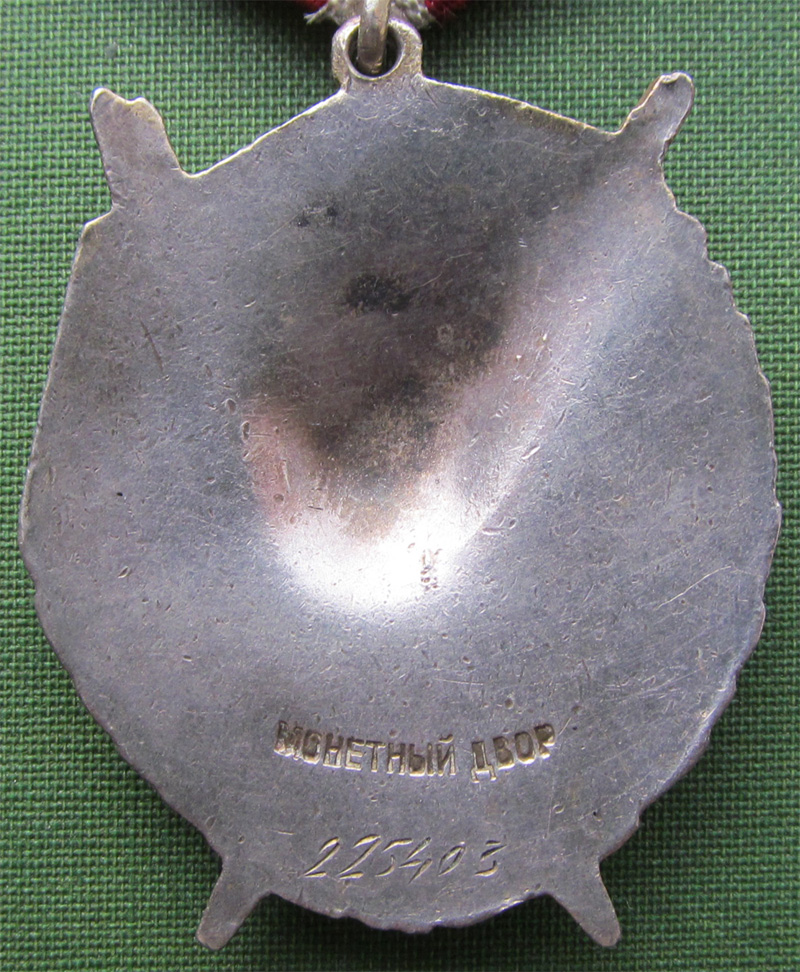
Mikhail Antonovich Potapov Order of the Red Banner nr. 225403 was awarded by Order of the 43rd Army of May 16, 1945 to 37-year-old Colonel Mikhail Antonovich Potapov, chief of the Operations Section of the 54th Rifle Corps, 43rd Army, 2nd Belorussian Front. 
Mikhail Antonovich Potapov was born on January 9, 1908 in the village of Volotovo in Stary Oskol District, in what at the time was the southeast of Kursk Province, in a working-class family. He went to high school in the city of Krasnodar, on the Kuban River in southern Russia. He left school in 1924, at the age of 16, and worked at an agricultural experiment station. It was likely during his time in Krasnodar that Potapov got married. With his wife Ekaterina, born in Krasnodar Province, he had two sons and a daughter. Potapov joined the army in Krasnodar in June 1929 and enrolled at a cavalry school in Krasnodar as a cadet, but three months later he was transferred to a school in Moscow. He graduated as an officer in March 1932 and was deployed in the Far East. He commanded a rifle platoon and later a machine-gun platoon in the. In late 1936 he was appointed as interim commander of a machine-gun company, a position that was formalized two years later. In December 1938 Potapov was promoted to Captain and in February 1939 he was given the position of chief of staff of a rifle battalion. In June 1941 Potapov enrolled in the Vystrel Course for battalion- and regiment-level command personnel. In November 1941 Potapov was appointed as chief of staff of the 4th Rifle Regiment in the 1st Red Banner Far Eastern Army's 98th Rifle Division, which was created the month before. In July 1942, the division was transferred to the front northwest of Stalingrad. The division took up position at Vertyachy on the Don as part of the 21st Army. On August 5, only days after arriving in the Stalingrad sector, Potapov suffered a contusion. Four days later, Potapov was promoted from chief of staff to commander of the 4th Rifle Regiment, even though he was still only a Captain. In mid-August the 98th was transferred to the 62nd Army. On the night of August 20 the division took part in a counterattack at the German bridgehead at Vertyachy, but without success. On August 23, German forces launched a strike from the bridgehead and broke through the Soviet defenses. The 98th then withdrew south to Karpovka, some 40 kilometers west of Stalingrad. The division did it best to assemble its men and then took up defensive positions slightly north, at Peschanny. On September 2, the 98th moved east and occupied defensive positions at the Stalingrad suburb of Gorodishche. On September 5, the remaining men of the 98th Rifle Division were transferred to a neighboring tank brigade and the staff left for Stalingrad. Here Potapov was slightly wounded on September 22. On September 30, the remainder of the 98th Rifle Division was transferred north to the Tambov area, between Stalingrad and Moscow, to be reconstituted. The remnants of the division reached the region on October 2. According to a later report, during the fighting at Stalingrad the division suffered horrible losses: 2600 men were killed in action, more than 4000 troops were wounded, and almost 2900 men went missing in action. It is likely that Potapov never joined his regiment at Tambov and stayed in the Stalingrad area: according to the same report the 4th Rifle Regiment had to make to at Tambov without its commander, deputy commander, chief of staff, and battalion and company commanders. Promoted to Major on November 4, Potapov was appointed as head of the junior lieutenant courses of the Stalingrad Front's 2nd Guards Army, operating southwest of Stalingrad. In July 1943 Potapov was given the position of the chief of the Operations Section of the 33rd Guards Rifle Division, another unit of the 2nd Guards Army. Like the 98th Rifle Division, the 33rd Guards had been practically destroyed at Stalingrad and was replenished at Tambov in October. In December 1942 it was deployed southwest of Stalingrad and was involved in repelling Field Marshal Von Manstein's relief effort. During the winter of 1942–1943, the division suffered heavy losses, and in late February 1943 it was transferred to the rear to rest and receive replenishments. In July, with Potapov having joined the division, the 33rd Guards Rifle Division took part in the Mius operation, after which the division advanced toward the Donbass. On August 27, 1943 Potapov was promoted to Lieutenant Colonel. In October he was awarded his first decoration, an Order of the Patriotic War, 2nd Class, for leading the Operations Section in an able manner during the Donbass operation, but also for visiting the units and leading combat operations from the front line. That same year Potapov joined the Communist Party. In the second half of 1943 the 33rd Guards Rifle Division advanced along the Black Sea coast line and in early 1944 the division closed in on Crimea. On March 31 the division crossed the Sivash lagoons separating Crimea from mainland Ukraine. The division took part in the liberation of Simferopol and Sevastopol, which was back under Soviet control on May 7. Later that month, Potapov was moved up a level and was named chief of the Operations Section of the 13th Guards Rifle Corps. Two months later he moved over to occupy the same post in the 54th Rifle Corps, at times also acting as deputy chief of staff of the 54th Rifle Corps. He would hold this position until after the war. In July 1944 the entire 2nd Guards Army was transferred from Crimea to the Baltics, where it took part in the advance across central Lithuania. In November 1944 the 54th Rifle Corps was transferred to the 43rd Army, taking part in the advance Memel, which created the Courland Pocket. In the second half of 1944 Potapov was awarded two Orders of the Red Star, again for ably leading the Operations Section and for transferring orders from corps command to the units on the front line, frequently being subjected to enemy fire. In early 1945 the East-Prussia campaign started, with the 43rd Army attacking Tilsit and then advancing toward Königsberg. These operations earned Potapov an Order of the Red Banner in February 1945. That same month, on February 20, Potapov was promoted to Colonel. On April 6 the assault on Königsberg started, after a four-day-long artillery bombardment. The 43rd Army attacked the city from the north and had cleared the northwestern parts of the city of German troops by April 8. The next day, Königsberg capitalated. For his actions during the Königsberg campaign and the operations to eliminate the German pocket on the Samland peninsula, northwest of Königsberg, Potapov was awarded his second Red Banner on May 16, 1945.The 43rd Army stayed in the area and after the German capitulation the next month it was attached to the Northern Group of Forces, stationed in Poland. In March 1946 Potapov was transferred to Taurida Military District and shortly served as a battalion commander in his home town of Krasnodar. In 1948 he attended another Vystrel Course, this time an eight-month course for regimental commanders, and in 1949 he was appointed as commander of the 193rd Mountain Rifle Regiment, and in 1952 he was designated as commander of the 12th Machine-Gun and Artillery Regiment in the Turkestan Military District. Mikhail Potapov retired from the army in February 1955 after almost 26 years of service. Over the course of his career he had been awarded the Order of Lenin, three Orders of the Red Banner, the Order of the Patriotic War, 2nd Class, two Orders of the Red Star, and three medals. Potapov passed away in 1981.Award citation 1. Last name, first name, and patronymic: Potapov, Mikhail Antonovich Nominated for: Order of the Red Banner 4. Year of birth: 1908 Brief, concrete description of his feat of arms or achievements: During the preparatory period prior to the operation to breach the heavily fortified enemy defenses at Königsberg, comrade Potapov organized the efficient duties of the Operations Section aimed at accomplishing its assignments. In carrying out the corps commander's orders he repeatedly, risking his life, personally ascertained the enemy's disposition and its units. During the fighting for the city of Königsberg and the operations aimed at liquidating the enemy Samland pocket, comrade Potapov managed to organize the duties aimed at accomplishing the corps commander's assignments. He repeatedly visited the frontline units of the 126th and 263rd Rifle Divisions under enemy fire. Risking his life he issued orders on site in the name of the corps commander in order to ensure that the corps commander's orders were executed properly and in a timely manner. Over the course of the offensive fighting for Königsberg and the Samland Peninsula, comrade Potapov promptly informed corps headquarters about the execution of its orders, in spite of the difficulties arising from the combat conditions. He monitored the accomplishment of combat objectives and demanded that the corps' units carried them out to the letter. Regardless of the difficulties he ensured that military dispatches and information were submitted to the army staff in a timely manner. For his personal heroism, bravery, and courage, for the feats he accomplished under combat conditions that involved a clear risk to life, comrade Potapov deserves to be awarded the Order of the Red Banner. Commanding officer of the 54th Rifle Corps 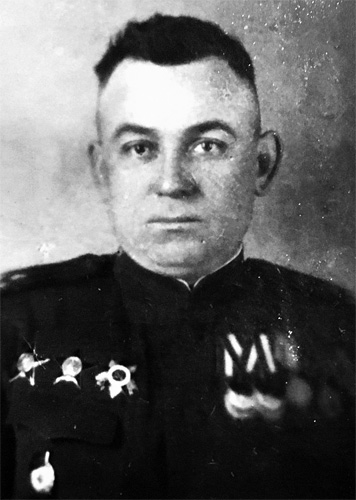
Mikhail Antonovich Potapov 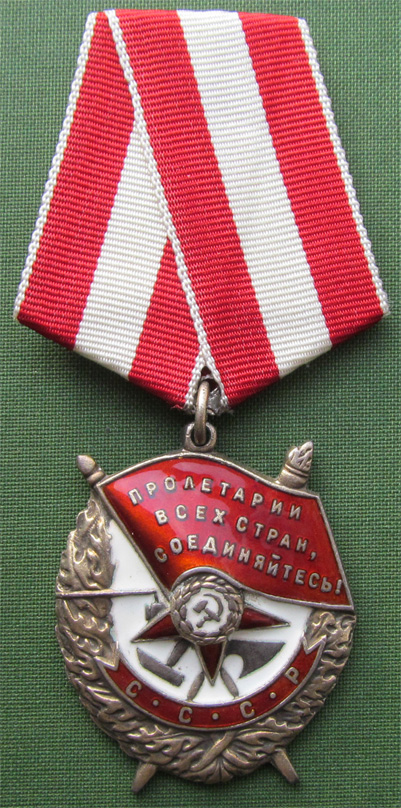
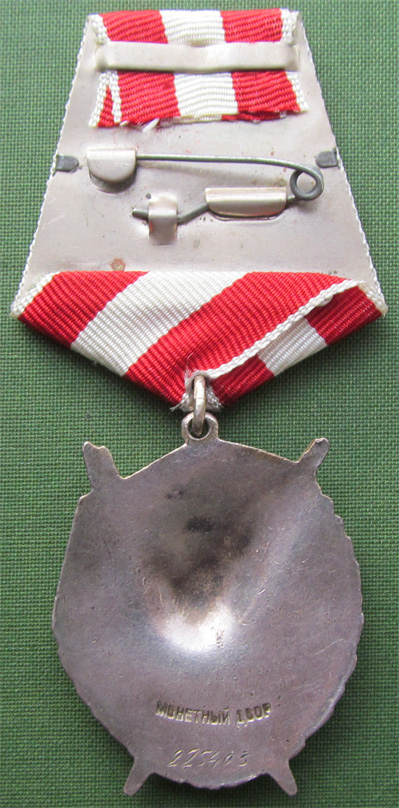
Order of the Red Banner nr. 225403, obverse and reverse 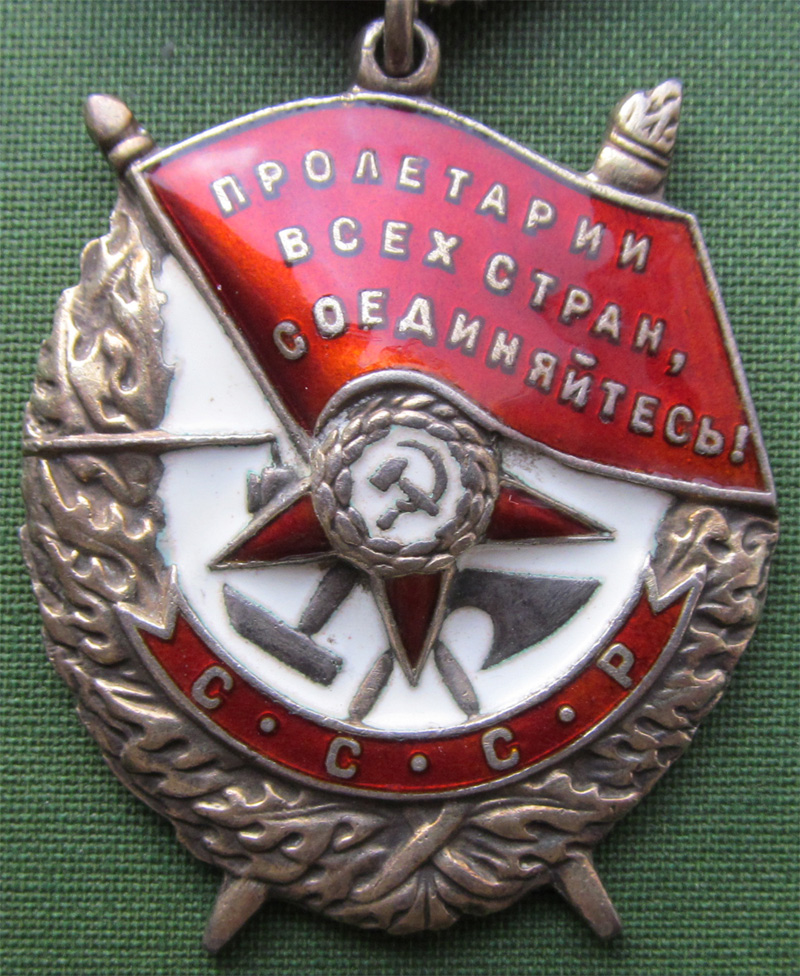
| |||||||||||||
All rights reserved / alle rechten voorbehouden © Auke de Vlieger 2008-
Home