|
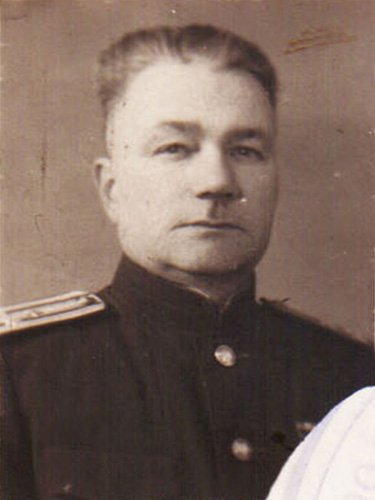
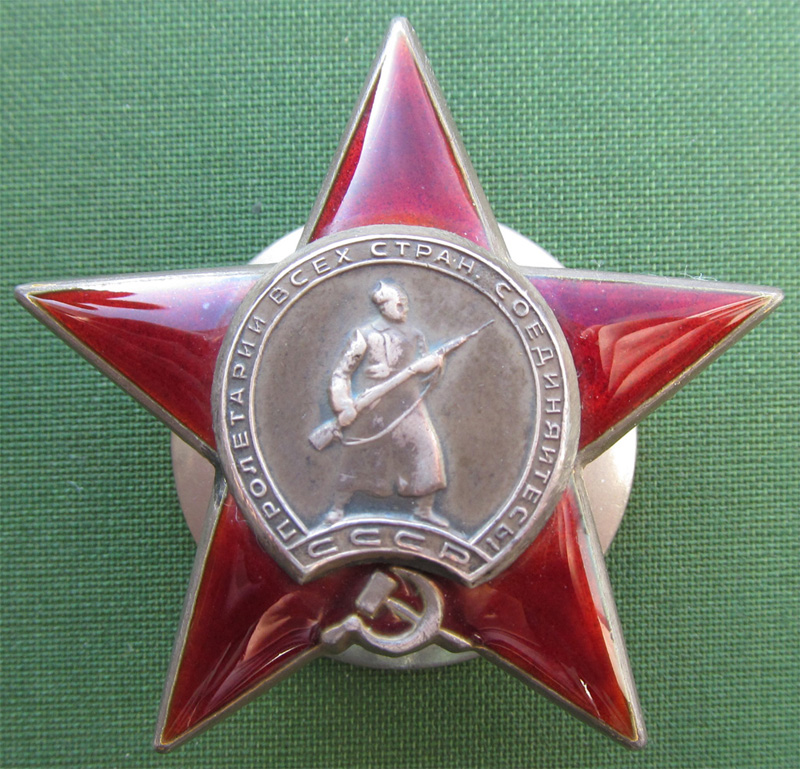
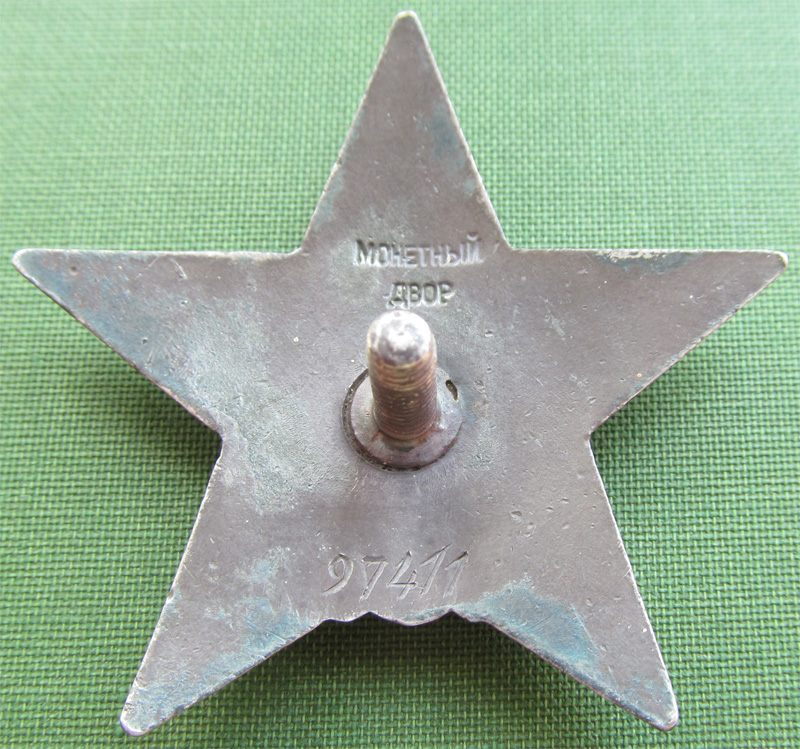
Mikhail Grigoryevich Veriga Order of the Red Star nr. 97411 was awarded by Order of the Don Front of February 28, 1943 to 35-year-old Major Mikhail Grigoryevich Veriga, assistant chief of the Operations Section of the 21st Army, Don Front. 
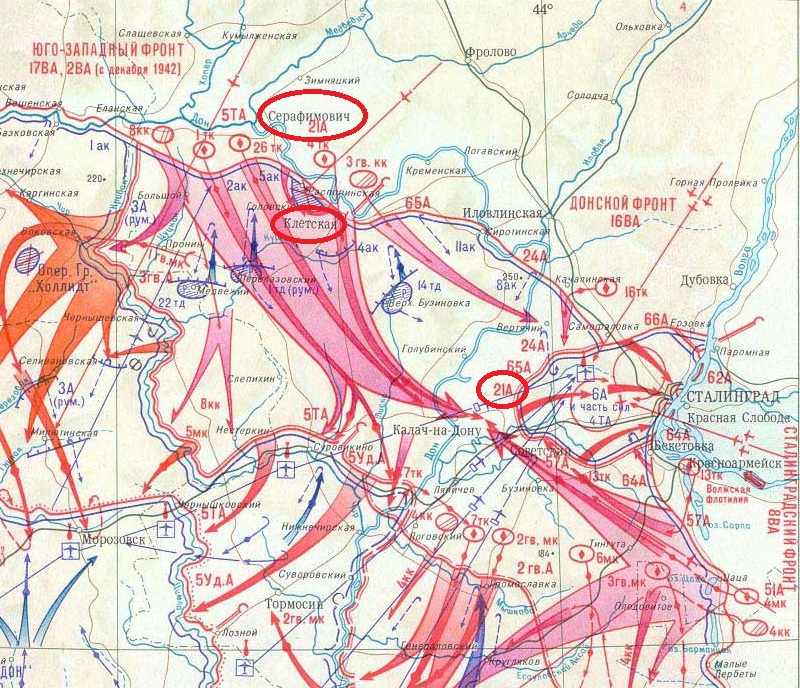
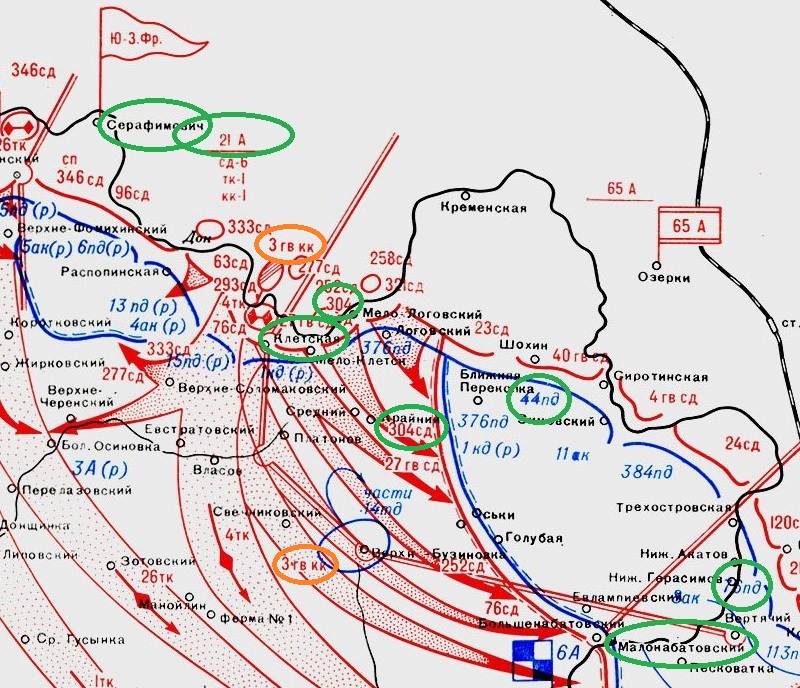
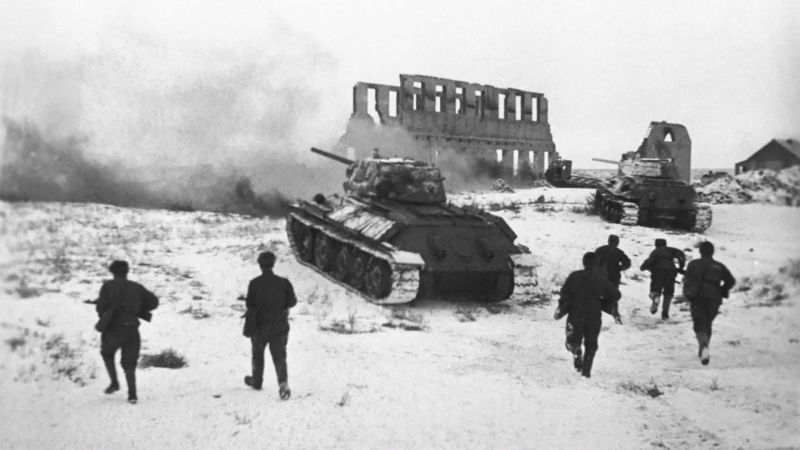
Mikhail Grigoryevich Veriga was born on November 15, 1907 in Senyukhin-Brod, a village near Pervomaisk in Southwestern Ukraine, in a family of peasants. He finished junior high school in 1921 and two years later he graduated from a technical school for railwaymen in Pervomaisk. On November 15, 1929 Veriga was drafted into the Red Army. He was recorded as being unemployed at the time. Veriga attended the regimental school of the 297th Rifle Regiment and served in that regiment as a non-commissioned officer for several years. During this time Veriga got married to a woman named Akulina, with whom he had two daughters, one born in 1934 and one born after World War Two. In November 1936 Veriga graduated from Kiev Infantry School, one of the oldest military schools in the Soviet Union, and was commissioned as a Lieutenant. For the next three years, Veriga served as a platoon leader, company commander, and battalion chief of staff in the 70th Rifle Regiment of the 24th Rifle Division - the Red Army's oldest rifle division. With the 70th Rifle Regiment - later redesignated as the 7th Rifle Regiment - Veriga took part in the campaign in Eastern Poland in 1939 and the Winter War against Finland of 1939-1940. Veriga was promoted to Senior Lieutenant in 1940 and in October of that year to was assigned as assistant chief of staff of another regiment of the 24th Rifle Division, the 168th Rifle Regiment. When Germany invaded the Soviet Union on June 22, 1941 the division was deployed at Molodechno, northwest of Minsk. Three days later, Veriga was promoted to chief of staff of this regiment. At this time the division was hit by General Hermann Hoth's 3rd Panzer Group, which formed the spearhead of the German left arm conducting an extraordinary envelopment of the Soviet armies in the large Białystok-Minsk double salient. At Minsk Hoth linked up with General Heinz Guderian's 2nd Panzer Group, advancing from the south. By June 30 they had encircled four Soviet armies, resulting in more than 400 thousand losses on the Soviet side. Not much later, in August 1941, Veriga was evidently transferred south to take up the post of assistant chief of the Operations Section of the 21st Army's 6th Rifle Corps, deployed in Western Ukraine. The Soviet Southwestern Front - including the 21st Army - gradually fell back to Kiev and the Dnieper, which came under direct German threat during July. Guderian's 2nd Panzer Group turned south in late August, threatening Kiev from the northeast. Southeast of Kiev, Army Group South crossed the Dnieper and in mid-September the two army groups linked up well east of Kiev, completing the most devastating encirclement of just World War Two. Five Soviet armies, including the 21st, were caught. The trapped armies attempted to break out of the pocket, but only a few thousand soldiers, mainly from the 21st Army and 5th Army, together with 500 men from 21st Army headquarters, were able to break out in the second half of September. Veriga must have been one of them. Well over half a million Red Army troops were taken prisoner; 620 thousand Soviet troops were recorded as killed, missing, and captured in the Kiev area between July 7 and September 26. Under constant German pressure, the residual elements of the 21st Army withdrew steadily in the direction of Belgorod. The 21st Army was rapidly replenished and in December Veriga was given command of a rifle battalion in the 1057th Rifle Regiment of the 297th Rifle Division. In February 1942 he was promoted to Captain and one months later Veriga attended the 21st Army's course for regimental commanders. However, instead of receiving such a command, Veriga was promoted to assistant chief of the Operations Section of the 21st Army. He would keep this post for more than three and a half years. In May the 21st Army took part in the failed Soviet attempt to take Kharkov. On June 28, the main German offensive of 1942 started. The 21st Army faced the left flank of Army Group South advancing on the Don and Stalingrad. In July the 21st Army was deployed further south to defend the left bank of the Don bend in the Serafimovich-Kletskaya sector. At Serafimovich and Kletskaya, the 21st Army had created substantial bridgeheads on the southern bank of the Don, which the Red Army held on to for the next few months. In August 1942 Veriga was promoted to Major, just half a year after his promotion to Captain. As the battle for the city of Stalingrad progressed, the 21st Army maintained the pressure on the German 6th Army and the Romanian 3rd Army on 6th Army's left flank. When the Red Army decided to envelop the German forces at Stalingrad, the two bridgeheads were to be used as the starting point for the offensive, which was launched on November 19. By the afternoon of the 19th, the 21st Army's two mobile corps had broken through the Romanian lines and on November 21, the tank corps reached the Don near its eastern extremity. Another Soviet army crossed the Don and linked up with the Soviet southern pincer, surrounding the 6th Army. A new large offensive, Operation Ring, was launched on January 10 to destroy the German pocket. On January 26, the 21st Army, advancing from the west, met the 62nd Army which had broken through the centre of the city, cutting the 6th Army in two. The German southern pocket surrendered on January 31 and the northern pocket on February 2. On February 2, 1943, the final day of the battle of Stalingrad, Veriga was nominated for the Order of the Red Star. Formally awarded on February 28, it was the first award of his career. In recognition of the part it had played in the battle of Stalingrad, the 21st Army was redesignated as the 6th Guards Army. The 6th Guards Army was transferred north and entrenched itself in the southern sector of the Kursk salient, where it faced the attacks of the German 4th Panzer Army. In August, after the battle of Kursk, the 6th Guards Army took part in the Belgorod-Kharkov offensive, after which the army was withdrawn and entered the reserves. On October 15, the Army was assigned to the 2nd Baltic Front and took up positions northwest of the city of Nevel. Until early January 1944 the Army was continually striking the flanks of the German 16th Army and 3rd Panzer Army and maintaining its positions. The 6th Guards Army was then transferred to the 1st Baltic Front in preparation for Operation Bagration, that year's summer offensive. In June 1944 Veriga was promoted to Lieutenant Colonel, and in July - as Operation Bagration was underway - he was promoted from assistant to senior assistant chief of the 6th Guards Army's Operations Section. In 1944 Veriga also became a member of the Communist Party and during the second half of the year he was awarded three awards - an Order of the Red Banner and Orders of the Patriotic War 1st and 2nd Class. Starting in February 1943, Veriga served as an informator in the staff of the 6th Guards Army, tasked with obtaining and providing information about the Army's troop dispositions and maintaining direct contact with the Front's Operations Section. During combat operations he briefed the 6th Guards Army's chief of Operations, Major General Everest Rybko, in a timely fashion and informed the Front staff about the way operations were progressing. Veriga spent a great deal of his time among the frontline units in order to ascertain the true state of affairs there, but he also carried out various other assignments from the Army staff. He verified whether instructions from Army command were carried out and he assisted local unit commanders. According to the chief of Operations, Veriga's reports ensured that Army command always possessed the relevant materials to make decisions concerning future stages of operations. By the end of July 1944, the 6th Guards Army was advancing on Riga from the southeast before turning west toward Memel on the Baltic coast. The 1st Baltic Front's aim was to cut off German forces in the northern Baltics from Germany, which was accomplished when one of its armies reached the coast just south of Memel in early October. Army Group North, trapped in the Baltics, withdrew toward the Courland Peninsula and was under constant pressure from multiple Soviet armies, but the Red Army was unable to break through the German defenses. In the end the 6th Guards Army and its neighboring armies launches various offensives over the next few months, but the German Courland pocket remained until the end of the war. Veriga stayed in the Baltics after the war. In January 1946 he was given command of a rifle regiment stationed in the Baltic region, but in 1947, with the downsizing of the Red Army, Veriga had to settle for the position of regimental chief of staff. In 1950 Veriga attended the Vystrel course for regimental commanders. The next year he was finally given command of a rifle regiment again and promoted to Colonel. During the final years of his military career Veriga would command various rifle regiments in the Baltic region and in Austria. Veriga retired from the Army in December 1955. He settled down in Vinnitsa in Western Ukraine, some 200 kilometers northwest of the town of his birth. For his service during the war, Veriga had been awarded an Order of the Red Star, two Orders of the Red Banners, and Orders of the Patriotic War 1st and 2nd Class. For long service he was awarded the usual Combat Merit Medal, Order of the Red Star, Order of the Red Banner, and finally, two months before his retirement, the Order of Lenin. Award citation All fields to be filled out fully
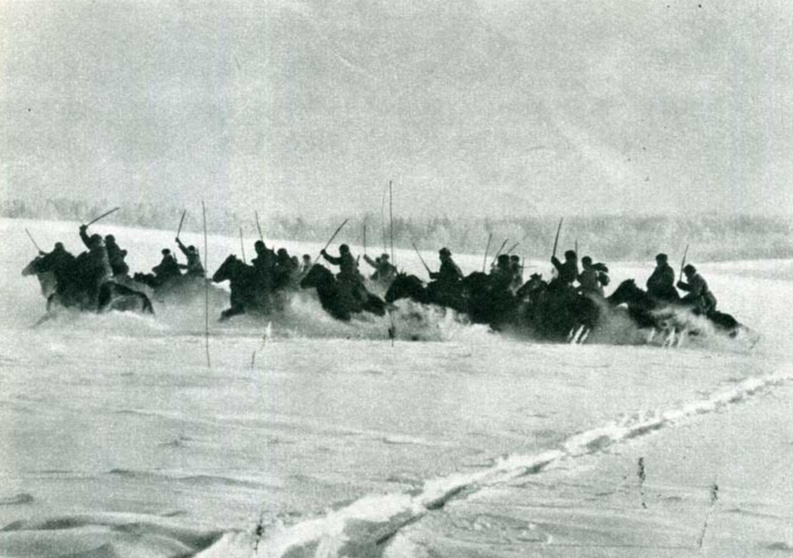
Last name, first name, and patronymic: Veriga, Mikhail Grigoryevich Nominated for: Order of the Red Star 1. Year of birth: 1907 Brief, concrete description of his feat of arms or achievements: During his service in the army staff's Operations Section, Major Veriga showed himself nothing but a fine worker who is able to ensure and demand that army command's orders are executed. During the army's fighting for the Serafimovich and Kletskaya bridgeheads in the 304th Rifle Division's sector, he secured an addition to the division commander's resolution. In executing said addition the division utterly annihilated an infantry regiment of the enemy's 79th Infantry Division and liberated two settlements. During the army's fighting for Malonabatovsky he aided in coordinating the actions of a cavalry corps operating in concert with two rifle divisions. As a result of this proper coordination, the 76th Infantry Division and the 44th Infantry Division suffered losses numbering up to 50 percent of their men. During the destruction of the encircled enemy forces at Stalingrad, comrade Veriga was involved in the direct preparations of the units and the men (on-site training for the upcoming operations). He familiarizes himself with situations in a fine manner and the information on our forces, which he has been charged to handle, is always complete. He deserves the Order of the Red Star. Deputy chief of staff of the 21st Army 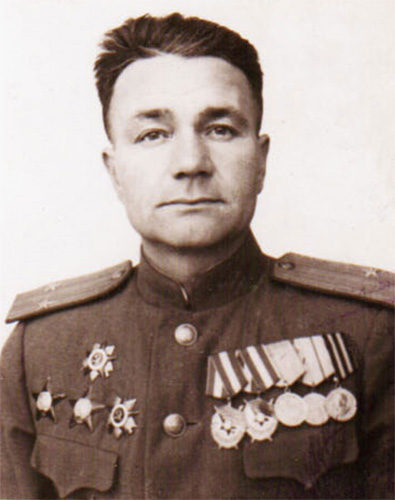
Mikhail Grigoryevich Veriga 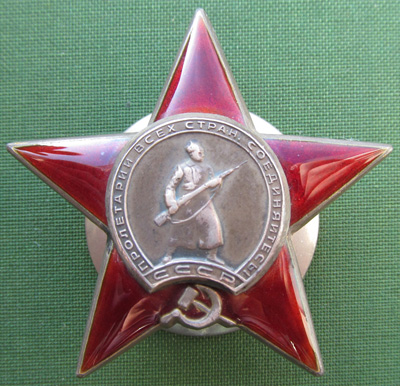
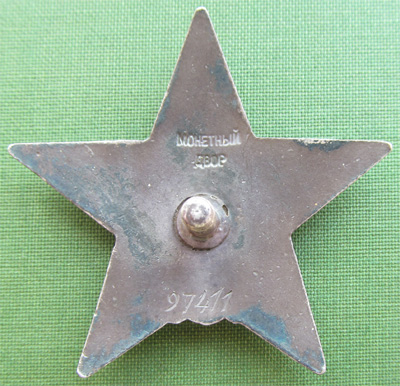
Order of the Red Star nr. 97411, obverse and reverse Click on the thumbnail to enlarge the image.
| |||||||||||||||||||||||
All rights reserved / alle rechten voorbehouden © Auke de Vlieger 2008-
Home