|
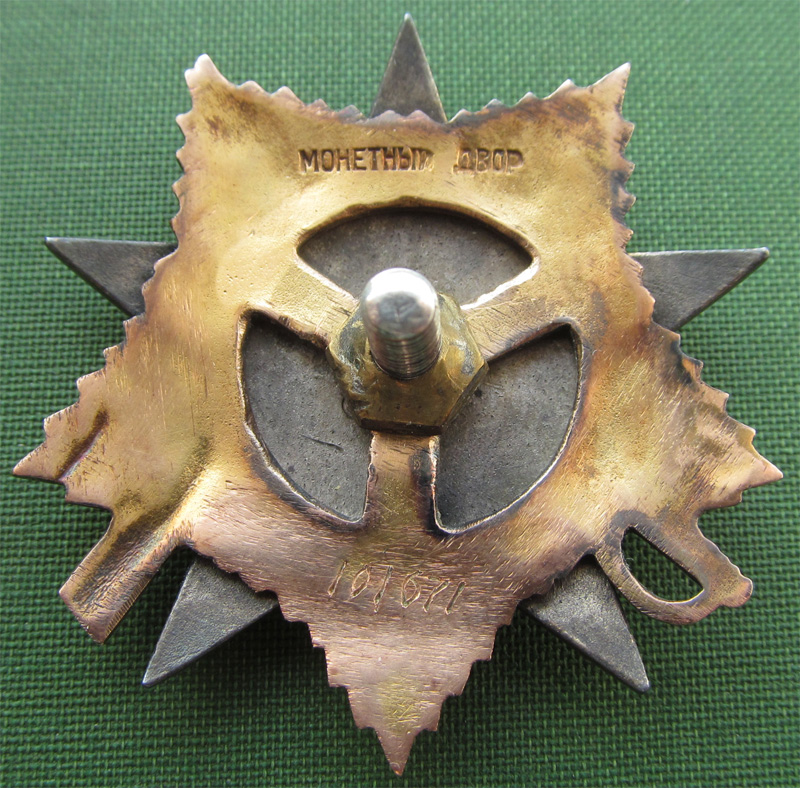
Nikolai Ivanovich Usanov Order of the Patriotic War, 1st Class nr. 101671 was awarded by Order of the Northern Fleet of December 31, 1944 to 35-year-old Senior Seaman Nikolai Ivanovich Usanov, senior engineman on minesweeper TShch-116, 6th Minesweeper Division, Defensive Sea Area Command, Fleet's Main Port, Northern Fleet.  Nikolai Ivanovich Usanov was born in 1909 to a family of peasants in the village of Bezrodnoye in Srednyaya Akhtuba District, a few miles east of Stalingrad. The village lies on the Akhtuba River, a left distributary of the Volga. Usanov had elementary education. Usanov joined the Navy in June 1941. He initially served at Novorossiysk Naval Base on the Black Sea, where he was an antiaircraft gun layer. He helped fight off several attacks by enemy aircraft. In October 1941 he was transferred to the Northern Fleet, where he served as a mortarman in the 82nd Independent Naval Infantry Brigade, one of the units defending the northern Kola Peninsula. In 1942 Usanov was assigned to the future crew of the minesweeper TShch-116, which was being constructed at Tampa Shipbuilding Company in Florida, USA. Originally laid down as the USS Arcade, the ship never saw service in the US Navy but was transferred to the Soviet Navy under the Lend-Lease act. She was handed over on the day of her completion, August 26, 1943, and commissioned in the Soviet Navy as TShch-116. She was a member of the Admirable class, a large class of 625-ton minesweepers that saw service in various navies. In addition to minesweeping gear these ships possessed rear-mounted depth charge racks, a forward-firing Hedgehog anti-submarine mortar, a 76-mm gun, four Bofors 40-mm antiaircraft guns, and six Oerlikon 20-mm guns. The ships had a complement of 104 officers and men. Usanov and his colleagues took over the ship and departed from St. Petersburg, Florida on October 5 to make the journey home. Usanov was the main engine's senior engineman and throughout the journey kept a careful eye on the engine under his charge. The ship arrived at Polyarny on November 24 and was attached to the Northern Fleet. One of the tasks of the Northern Fleet was escorting convoys through the Soviet Arctic region. One of these convoys, BD-5, consisted of the 7540-ton freighter Marina Raskova and her three escort vessels, the minesweepers TShch-114, TShch-116, and TShch-118. Marina Raskova's holds were filled with 6600 tons of provisions, machinery for construction projects, and technical equipment. In addition she transported 354 replacement personnel for polar outposts. Many of them took their families along, and therefore the passengers included 116 women and more than 20 children. The transport had a crew of 51, in addition to 5 military signallers and a few antiaircraft gunners. Bound for Dikson Island and other destinations in the Kara Sea, the convoy departed the White Sea port town of Severodvinsk on August 8, 1944. The convoy was led by 40-year-old Captain Aleksandr Shmelyov, commander of the Northern Fleet's Minesweeper Brigade, who flew his flag on TShch-118. The flagship took up position 1 mile ahead of Marina Raskova; the other two escorts positioned themselves 1.2 miles off her port and starboard sides. A few minutes before 8 PM on August 12, when BD-5 was about 60 miles west of Bely Island, off the northern end of Yamal Pensinsula, A dull underwater explosion rocked Marina Raskova and a large splash was visible on her starboard side. Her boilers inoperative, she ground to a halt and lurched slightly to starboard. Since no submarine was detected, the convoy commander and the flagship captain considered a mine the likely cause of the explosion. TShch-118 turned around to assist the stricken ship and TShch-116 was ordered to do the same. TShch-114 was ordered to search for an enemy submarine. The flagship was about 400 yards from Marina Raskova when a few minutes after 8 PM she too suffered an explosion, near her stern. Her machines out of action, TShch-118 ground to a halt and quickly took on water. She started going down by the stern and even though repair crews tried to contain the damage, Captain Shmelyov realized the ship could not be saved and ordered the TShch-118 to be abandoned. Convinced his convoy had entered a minefield, Shmelyov by semaphore ordered the other two minesweepers not to approach and to use only small boats to rescue the survivors. TShch-116 lowered her boats and evacuated the surviving crew members of TShch-118. Meanwhile, TShch-114, not finding any trace of a submarine, abandoned her search and aided in the rescue of the survivors of TShch-118. She also had her boats approach the Marina Raskova to take off some 200 people, including 136 women and children. Over the next few hours, the freighter settled lower and lower in the water and her demise was inevitable. By midnight, in stormy weather, TShch-116 sent a boat to take the remaining crew members of Marina Raskova on board. At 00:45 AM, a large explosion in the center of the ship rocked TShch-114. Her stern broke off and she instantly sank to the bottom. The rest of the ship went down within four minutes. Only 26 people made it into the lifeboats. Convoy commander Shmelyov, who was rescued by TShch-114, was one of those who died. Crew members of TShch-114 reported to TShch-116's skipper, 27-year-old Lieutenant Vasily Babanov, that they had seen a periscope at the moment of the attack. Babanov faced the difficult choice of either pursuing the submarine, with 186 shipwrecked men, women, and children on board and no help available in case his ship would founder, or turning home. He decided on the latter, with the intention of returning to the scene of the attack later to rescue the last people in the drifting sloops and rafts - according to estimates, some 120-180 people in all. As TShch-116 withdrew, the German submarine responsible for the sinkings, U-365 under Kapitänleutnant Haimar Wedemeyer, put two final torpedoes in Marina Raskova, sealing her fate. Over the next 21 days, search and rescue operations were conducted to try and save survivors. Many aircraft and ships, including TShch-116, assisted in the operation. Several dozen people were saved, but at least 378 people had lost their lives in the attack on convoy BD-5. It was the greatest tragedy in the history of the Arctic convoys during World War Two, with much greater loss of life than the famous convoy PQ 17. The BD-5 convoy escort mission was just one of 41 combat missions Usanov was involved in as a crew member of TShch-116 by September 1944. On September 6, 1944, near Uyedinenia Island in the Kara Sea, TShch-116 depth-charged the German U-boat U-362. The U-boat sank with all hands (51 men). She was one of five German U-boats sunk by the Soviet Navy. For Usanov's quick response when the fuel purifier stopped working during the sinking of the submarine, skipper Babanov nominated him for the Order of the Patriotic War, 1st Class, which he was awarded on the last day of the year. 1944 was also the year in which Usanov joined the Communist Party. In the first half of 1945, TShch-116 carried out another 44 combat missions, clearing 18 sea mines. During these sorties, the minesweeper helped fight off 12 attacks by German submarines. On April 25, 1945 TShch-116, which was escorting a convoy of 11 Allied merchant vessels carrying valuable cargoes, helped ward off a German submarine that attempted to launch its torpedoes at the merchantmen. During the attack, Usanov once again was in charge of the main diesel, making sure it operated smoothly. According to his skipper, Usanov carried out all orders promptly and to the letter, thus aiding in the sinking of the U-boat. TShch-116 claimed to have sunk the submarine, but in fact it managed to get away. For his efforts during the attack on the U-boat Usanov was awarded the Ushakov Medal, which was bestowed a few weeks after the end of the war in Europe. After the war, Usanov served as an engineman on minesweeper AM-126, which served in the Northern Fleet in a coastal protection role. Usanov left the Navy in October 1945. In addition to the OPW1 and Ushakov Medal he was awarded the Medal for the Defense of the Polar Region. After the war Usanov returned to the Stalingrad area; he worked as a mechanic at the 'Third Decisive' collective farm in Krasnaya Sloboda, a district of Stalingrad on the far side of the Volga, where he also lived. Award citation Concerning: Senior Seaman Nikolai Ivanovich Usanov, senior engineman on minesweeper TShch-116, 6th Minesweeper Division, Defensive Sea Area Command, Northern Fleet Nominated for: 1. Year of birth: 1909 Brief, concrete description of his feat of arms or achievements: Nikolai Ivanovich Usanov has been participating in the Patriotic War against the German-fascist invaders since 1941. He served at Novorossiysk Naval Base of the Black Sea Fleet as a gun layer, fighting off enemy aerial attacks. In October 1941 he was transferred to the Northern Fleet to serve as a mortarman in the 82nd Brigade. In 1942 he was assigned to a special crew manning TShch-116 and sent on a government mission to the USA. He took part in carrying out the government mission of delivering the vessel from the USA to the motherland. Throughout the voyage he vigilantly stood watch at the main engine. He personally took part in executing 41 combat missions. In 1944 the vessel sailed 17,627 miles and 500 miles with minesweeping gear deployed and served as convoy escort for 90 transport ships. During the sinking of an enemy submarine he serviced diesel generator number 1, which worked smoothly. Due to heavy depth charge explosions the fuel purifier ceased working. Knowing that if the fuel would not be swiftly moved to storage tanks the entire combat operation might have to be aborted, comrade Usanov rapidly brought the fuel purifier back online and topped off the fuel storage tanks, thus ensuring the combat operation aimed at sinking the submarine could be accomplished. For the bravery and courage he displayed in combat against the German-fascist invaders during the sinking of an enemy submarine, I nominate him for the Order of the Patriotic War, 1st Class. Commanding officer of minesweeper TShch-116 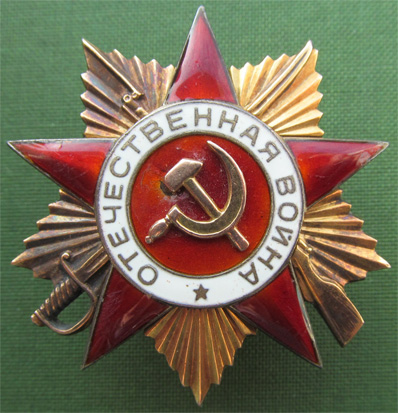
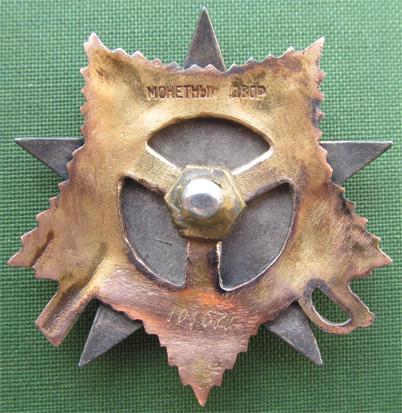
Order of the Patriotic War, 1st Class nr. 101671, obverse and reverse 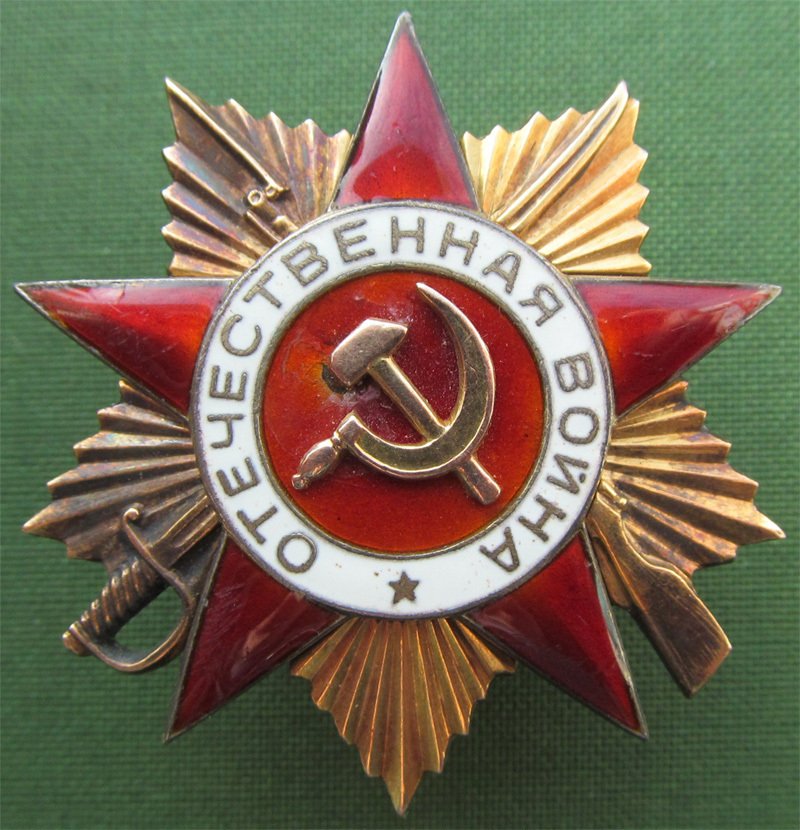
|
All rights reserved / alle rechten voorbehouden © Auke de Vlieger 2008-
Home