|
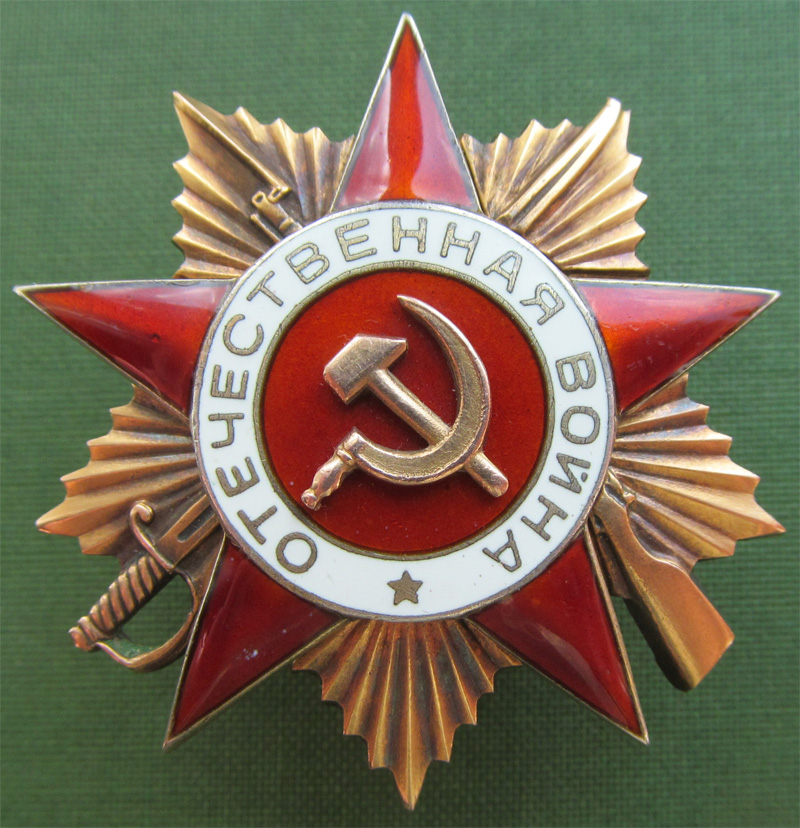
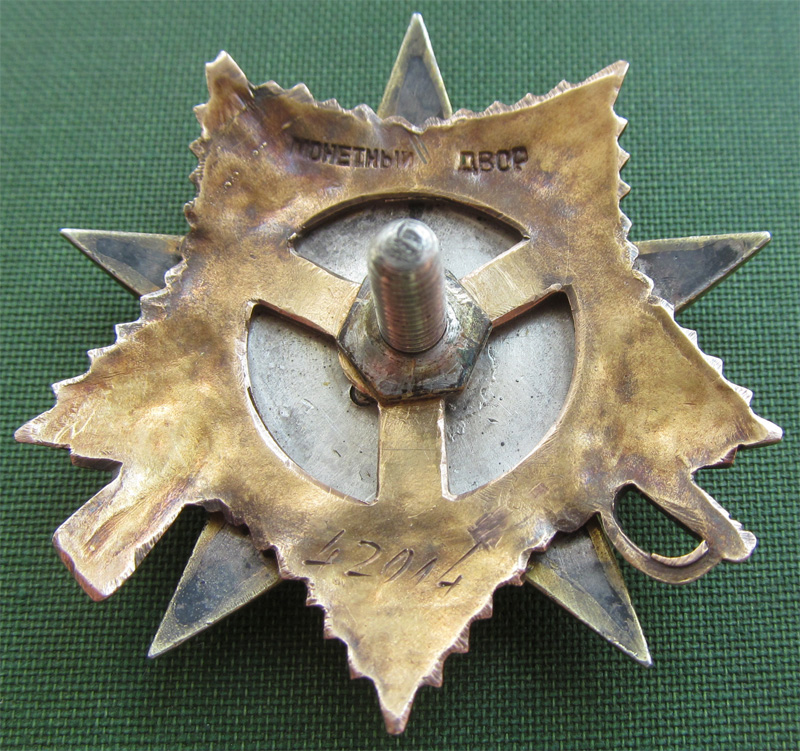
Gavriil Nikolayevich Argunov Order of the Patriotic War, 1st Class nr. 42014 was awarded by Order of the artillery commander of the Leningrad Front of March 8, 1944 to 31-year-old Guards Captain Gavriil Nikolayevich Argunov, commander of the Headquarters Battery of the 21st Super Heavy Guards Howitzer Artillery Brigade of the Reserve of the High Command, 23rd Breakthrough Artillery Division, 3rd Breakthrough Artillery Corps, Leningrad Front. 
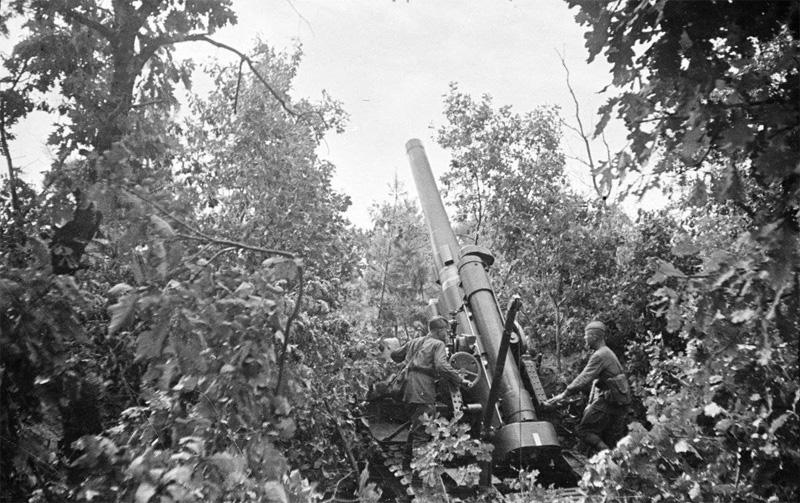
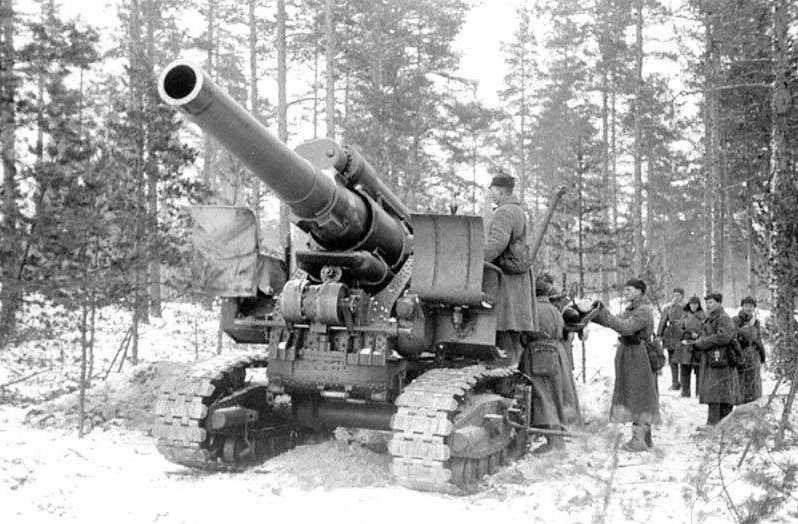
Gavriil Nikolayevich Argunov was born on April 22, 1912 in the village of Peschanoye, a few kilometers east of Kharkov in Eastern Ukraine, in a family of peasants. After high school Argunov worked as a clerk before enlisting in the Red Army on November 2, 1934. After serving as a scout, a squad leader, and a deputy platoon leader for several years Argunov attended his unit's course for junior lieutenants in 1938. In 1939 Argunov finished the course, was promoted to Junior Lieutenant, and assigned as a platoon leader in the 168th Super Heavy Howitzer Artillery Regiment. The 168th Regiment was equipped with B-4 howitzers, which fired 203-mm shells. Pulled by S-65 'Stalinets' tractors, this was the heaviest howitzer type in use by the Red Army during the Second World War. Due to this exceptional caliber, brigades equipped with the B-4 howitzer were called 'Super Heavy' (bolshoi moshchnosti). Brigades employing the lesser 152-mm howitzers were just called 'Heavy'. All B-4 howitzer units were part of the so-called 'Reserve of the High Command', whose large-caliber artillery was employed to demolish particularly tough fortifications and important objectives. The gun in its entirety weighed 17.700 kilograms and fired 100-kilogram shells. It was manned by a crew of fifteen. One gun formed a platoon, two platoons made up a battery, and battalions were divided into three batteries. The regiment as a whole had four battalions, although two battalions were removed in 1942. With this regiment Argunov took part in the Winter War against Finland. The 168th Regiment and several others (overall, 142 B-4 guns were used by the Red Army during the war with Finland) were used to break through the concrete structures of the Mannerheim Line on the Karelian Peninsula, where Soviet soldiers gave the gun its nickname of 'Karelian sculptor'; the Fins called it 'Stalin's sledgehammer'. After the Finnish war the regiment was moved south and took part in the Soviet occupation of Bessarabia and Northern Bukovina. In March 1941 Argunov was promoted to chief of reconnaissance of the 168th Regiment. When Germany invaded the Soviet Union in June 1941, the 168th Regiment was deployed at Chertkov, southeast of Lvov in Western Ukraine. Counting 2309 men, the regiment supported the 12th Army. Ordered to withdraw to Borispol, east of Kiev, by train, the regiment was attacked by German aircraft as the trains were being loaded. 15 men were killed or wounded and two guns mounts were taken out of action. These were the only material losses the regiment would sustain during the war. In order to preserve the B-4 howitzers, which were unsuited for maneuver warfare, the regiment withdrew even further: in late July the regiment was transferred to Chuguyev, near Kharkov. In September Argunov was assigned as headquarters battery commander in the 168th Regiment and the unit was transported another thousand kilometers east, to the Kazan area. After training exercises the regiment was put on trains again and deployed west of Moscow in November 1941 in order to help thwart the German attempts to cross the water reservoirs in this area. Although it spotted German forces, the regiment did not engage in battle. After the Soviet counterattack at Moscow, the regiment was transferred to the Leningrad area. It arrived on the Volkhov River, north of Novgorod, in early February 1942 to support the 59th Army. On February 4 the howitzers opened fire on German defensive structures for the first time. The German defenses here were mostly made of wood, however, which the Soviet 203-mm heavy howitzers were overqualified to deal with. Although it did lead to some successes in the 59th Army's Chudovo-Lyuban sector, the expenditure of large numbers of high-caliber shells was costly. As headquarters battery commander, one of Argunov's tasks was to oversee the teams building observation and command posts for the regimental commander and his staff. In late May 1942 the regiment moved north to help crush enemy resistance at Kirishi, during which Argunov was constantly stationed at one of the observation posts, looking for signs of the enemy. His regimental commander assessed Argunov as an energetic leader and "a man of great personal bravery and courage". One June 26, 1942, during a relatively long break in the fighting, 25 German bombers suddenly appeared, wreaking heavoc among the positions of the 168th Regiment. Argunov was able to evacuate his equipment and his vehicle, but the regiment lost a considerable number of men. For these efforts Argunov was awarded the Medal for Combat Merit. In August the regiment was transported further north, to the sector of the 8th Army. It arrived three days before the Volkhov Front started its Sinyavino offensive on August 27. Since a corridor of only 16 kilometers separated the Leningrad Front in the city from the Volkhov Front just south of Lake Ladoga, this was where the Red Army attempted to break the siege of Leningrad. On that first day of the offensive, the 168th Regiment fired 916 shells at enemy structures, which turned out to be more solidly built than fortifications previously hit by the B-4s. Nevertheless, the operation as a whole was a costly failure, but the Red Army tried again in January 1943. This new attempt, Operation Iskra, did result in an overland connection to Leningrad. In January 1943 Argunov was awarded the Order of the Red Star for his actions during the Sinyavino operation. Argunov joined the Communist Party in 1943. In June 1943 his regiment was raised to guards status, becoming the 224th Super Heavy Guards Howitzer Artillery Brigade. One month later, the regiment was turned into a brigade and named the 21st Super Heavy Guards Howitzer Artillery Brigade. It was the first 203-mm howitzer brigade of the Red Army receiving the coveted guards designation. The brigade consisted of four battalions - the same strength the regiment had had at the start of the war - even though the regiment's on-paper strength was some 2500 men and the brigade officially had just 1327 men. The The brigade possessed 24 howitzers. After the fighting at Sinyavino, the brigade turned south. In early 1944 the brigade turned its focus on Pushkin, Krasnoye Selo, and Gatchina, south of Leningrad. Here for the first time the brigade encountered bunkers made of steel and concrete, which the B-4 was designed to destroy. These operations were followed by the advance on Narva, on the Estonian border. For the operations south of Leningrad and the advance in the Narva sector, Argunov was awarded the Order of the Patriotic War, 1st Class on March 8, 1944. Argunov was later transferred to another brigade in the same division, the 3rd Heavy Howitzer Artillery Brigade, to serve as its headquarters battery commander. This brigade was equipped with 152-mm 'heavy' howitzers instead of the 203-mm 'super heavy' type. The brigade had 32 of these guns. As Argunov's division started heading west, it was transferred from the Leningrad Front to the 2nd Belorussian Front in November 1944. Under this front it would operate until the end of the war. From Estonia the division advanced into Latvia, East Prussia, and then Northern Poland. Via Elbing, Graudenz, and Danzig it advanced toward the Oder. During the Oder crossing operation Argunov again distinguished himself. On April 21 he was stationed at the brigade commander's observation post and started looking for enemy gun emplacements on his own initiative. Argunov detected three operational machine gun nests, which were subsequently destroyed by howitzer fire. For his actions during the Oder crossing operation, Argunov was awarded a second Order of the Red Star on May 12, three days after the German capitulation. Argunov's brigade supported the 49th Army in its push toward the Elbe, where it met up with forces of the British Second Army. For Argunov's brigade the war ended at the village of Mentin in the Ruhn Hills, 150 kilometers northwest of Berlin. After the war Argunov was assigned as a deputy battalion commander for personnel in the 551st Corps Artillery Regiment. He probably retired from the army not long after. Award citation Last name, first name, and patronymic: Argunov, Gavriil Nikolayevich Nominated for: Order of the Patriotic War, 1st Class 1. Year of birth: 1912 Brief, concrete description of his feat of arms or achievements: During the operation conducted south of Pulkovo, comrade Argunov was continuously stationed at the command and observation post, ensuring that all of the brigade's technical means required for fire direction were functioning efficiently. From the mobile observation point comrade Argunov personally spotted 6 wooden bunkers near Aleksandrovka and Bolshoye Vittolovo, which on day one of the battle were destroyed by our artillery. During the fighting to seize heigh 104.6 comrade Argunov was reconnoitering from the mobile observation post for 24 hours on end. He was stationed 200 meters from the enemy's front line en personally adjusted artillery fire by radio, ensuring that 4 enemy wooden fortifications, which had been impeding the advance of our units, were pulverized. In the Narva sector comrade Argunov was conducting reconnaissance from the mobile observation post, ensuring effective fire at a concentration of tanks. They were dispersed, which enabled our advancing units to seize favorable positions. Comrade Argunov was particularly meritorious in maintaining uninterrupted communications under the most difficult combat conditions of the last few days. On February 23, when comrade Argunov was subjected to bombardment at the observation post, he did not seize observing and conducting reconnaissance until he had definitively determined the locations where enemy troops were asembling. For the exemplary and brave execution of combat missions in the struggle with the German invaders comrade Argunov deserves the Order of the Patriotic War, 1st Class. Commanding officer of the 21st Super Heavy Guards Howitzer Artillery Brigade of the Reserve of the High Command 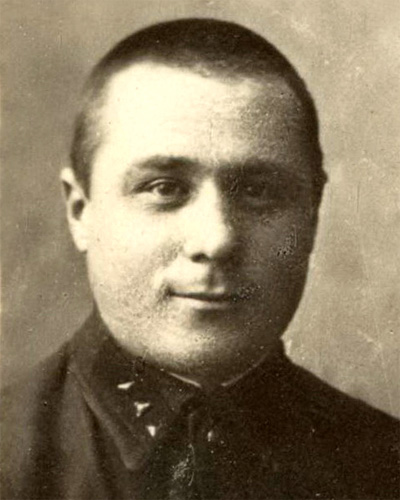
Gavriil Nikolayevich Argunov 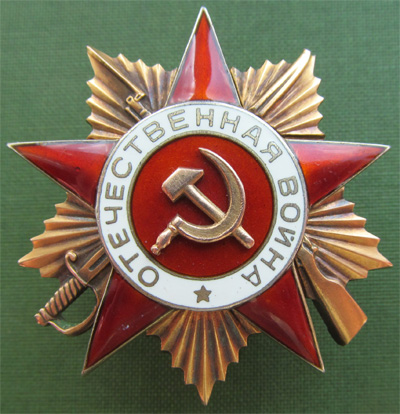
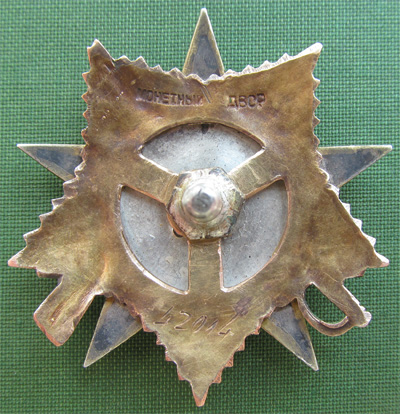
Order of the Patriotic War, 1st Class nr. 42014, obverse and reverse Click on the thumbnail to enlarge the image.
| |||||||||||||||||
All rights reserved / alle rechten voorbehouden © Auke de Vlieger 2008-
Home